

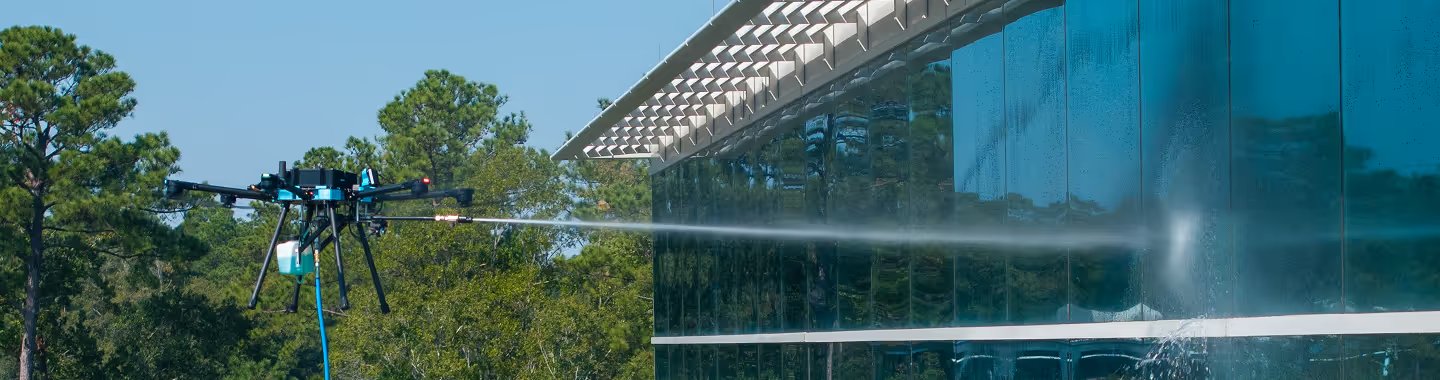
In an era where “embodied AI” is no longer science fiction but front-line deployment, Lucid Bots is making headlines. The company’s flagship platform, the Sherpa Drone, has recently been upgraded with painting and coating modules, enabling large-scale exterior building work formerly reliant on human labor. As CEO Andrew Ashur puts it: “Robots are the arms and legs of AI” – a phrase that captures both the promise and the unease of this moment. What does this shift mean for business owners, for workers, and for the evolving nature of work? Let’s explore.
Demand Meets Labor Shortage
The timing of Lucid Bots’ move into painting and coating is no accident. As infrastructure spending surges and labor shortages bite in the construction and building-maintenance sectors, automation becomes a strategic answer. For example, Lucid Bots’ announcement points to a $237 billion market and claims the Sherpa Drone’s painting module achieves up to 3× faster results at nearly half the cost compared with traditional methods. The work is dangerous too, heights, scaffolding, lifts, and crews in challenging environments all add risk. Automation appears as a win for business owners: faster, cheaper, safer. But the flipside is the human cost.
“Arms and Legs of AI” — The Meaning of Embodied Intelligence
The phrase “robots are the arms and legs of AI” is more than marketing, it signals a shift from AI that just thinks to AI that acts. Lucid Bots highlights that their system doesn’t just “sense and observe,” but performs: “For the first time, robots can handle complex, real-world tasks like commercial painting at scale.” The Sherpa Drone uses modular attachments, allowing a swap-in painting or coating payload on a system already in the field. That kind of modularity reinforces the metaphor: the brain (AI) stays constant, and the arms and legs (robots) extend into new jobs. Yet such extension raises real questions about job displacement, control, and human-machine interaction.
The Unspoken Risk — Job Displacement and Workforce Transition
With adoption of robots like the Sherpa Drone, business owners face a trade-off: invest in automation and reduce labor costs but what happens to the people who previously did those jobs? Traditional painting and coating crews, scaffolding operators, lift drivers, these roles face pressure. When a platform claims to finish a job in a day that previously took several, and at far lower cost, the ripple effect is real. Moreover, the unknowns are substantial: Will these displaced workers be retrained? Are companies accountable? And what are the societal implications when many jobs are “automated away”? The risk isn’t just economic; it’s reputational and ethical as well.
New Jobs — Humans Might Shift From Doing to Orchestrating
However, this isn’t purely a story of loss. New roles will arise. Someone needs to operate, monitor, maintain, refill, and orchestrate these robotic systems. In fact, Lucid Bots emphasises they build, deploy, service, and scale robots in the field, logging their “Robot Operating Minutes” and tracking operational data for continuous improvement. The jobs may shift: fewer manual laborers painting walls at heights, more drone‐system technicians, payload specialists, robotics orchestration managers, data analysts reviewing performance logs, and business owners deciding which tasks to automate. For business owners this offers a new value chain; for workers it offers an alternative track, assuming the transition is managed.
Business Owner Considerations — When to Automate and When to Humanize
For business owners, the calculus is complex. On one hand, automation promises faster job cycles, reduced safety risk, and lower costs. On the other hand, investing in new robotics systems requires capital, training, change management, and readiness for unknowns. Questions they should ask include:
- Does the robotic solution deliver radical ROI (and not just incremental)? Lucid Bots emphasises up to 3× faster and almost half the cost.
- What is the transition plan for existing workforce?
- How will liability, regulatory compliance (especially with drones), insurance, and height work change?
- How will the orchestration and maintenance roles be staffed and backed up?
In effect, adopting robots means shifting from a direct labor model to a hybrid robotics+human model. Business leaders must guide the change consciously.
Broader Implications for the Workforce — Skills, Training, and Equity
Because systems like the Sherpa Drone don’t entirely eliminate human involvement, the mix of skills required is shifting. Workers may need upskilling in robotics operation, sensor diagnostics, software interface control, payload module swap-ins, and even data logging. The risk is that those who are unable or unwilling to transition get left behind. There’s also a geographic and demographic dimension: maintenance crews, building-service workers, coatings contractors, many come from trade backgrounds. If automation accelerates without parallel training infrastructure, the equity gap could widen. Conversely, companies that embed retraining and new role creation may benefit both socially and economically.
Looking Ahead — The Unknown Space of Risk and Reward
As Lucid Bots and similar companies scale up, we are entering a partly unknown space. How rapidly will adoption happen? What regulation will drone-based painting face? How will insurance and liability evolve? What happens when one contractor automates and a competitor does not? There’s also the “second-order” workforce question: as robots become more common, will demand shift entirely to robotic orchestration firms, leaving traditional contractors behind? Companies and workers alike must prepare for these changes — proactively, thoughtfully, and ethically.
“As AI takes on more of the world’s labor, our greatest job is ensuring it serves the people who built the world in the first place.”

Leave a Reply