

Tesla’s Biggest Bet Isn’t an Electric Car Anymore
Tesla Cybercab computer vision is moving from an ambitious AI experiment toward a real-world transportation platform. For years, Tesla’s identity was inseparable from the electric vehicle revolution. But its latest Cybercab rollout suggests the company is pursuing something much bigger than simply selling EVs.
Table of Contents
Tesla wants the vehicle itself to become an autonomous AI system.
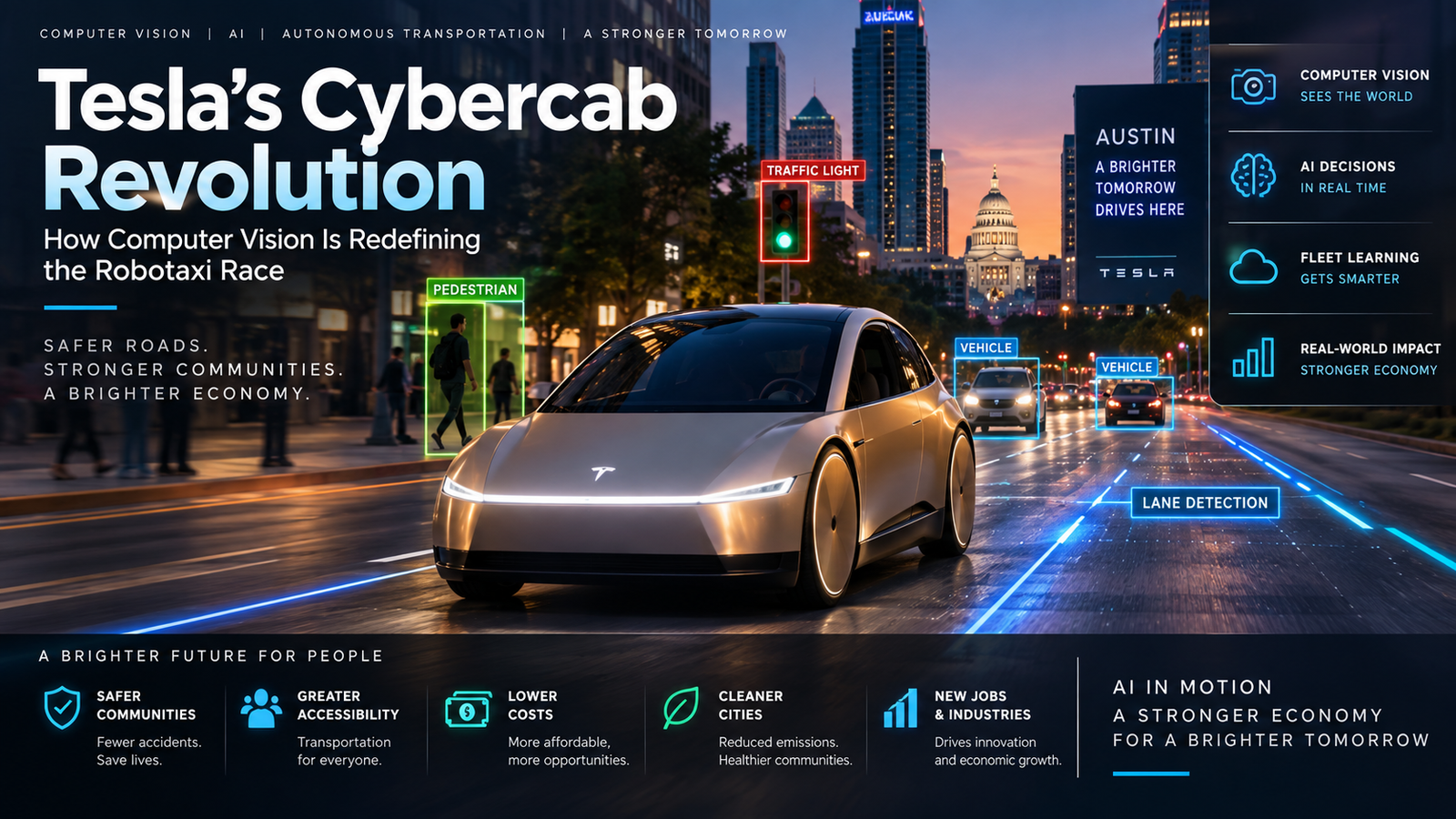
The arrival of Cybercab brings that vision into sharper focus. In September 2026, Tesla began offering limited rides in Austin using its purpose-built Cybercab — a two-seat autonomous vehicle designed without a steering wheel or pedals. It represents a major shift in Tesla’s strategy: from building cars that assist drivers to building vehicles designed around the idea that a human driver may eventually be unnecessary.
Teaching a Car to See
Computer vision is a branch of artificial intelligence that allows machines to interpret visual information from cameras and make decisions based on what they see.
For an autonomous vehicle, that means recognizing lanes, pedestrians, traffic lights, other vehicles, intersections, road boundaries and countless unexpected situations — and then determining what to do next.
Tesla’s FSD system uses eight high-resolution exterior cameras providing a 360-degree view around the vehicle. Tesla combines that visual information with its onboard computer and custom silicon to interpret the environment and determine how the vehicle should navigate it.
The interesting part isn’t simply that Tesla has cameras.
It’s the scale behind them.
Tesla says its global fleet can collect the equivalent of more than 500 years of continuous driving data every day. That creates a powerful feedback loop: vehicles encounter real-world situations, those situations can contribute to improving AI models, improved models can be distributed through software updates, and the fleet continues generating new driving experience.
That turns millions of vehicles into something more than transportation.
They become part of a massive real-world AI data engine.
From Pixels to Decisions
Tesla’s approach increasingly resembles the development of a physical AI system rather than traditional automotive programming.
At CVPR 2026, Tesla described its autonomy work as using end-to-end models and highlighted what it calls a massive embodied-AI dataset gathered from its vehicle fleet. Tesla has also described its robotics models as working in an end-to-end “pixels-to-actuation” fashion — essentially transforming visual observations into physical actions.
Think about what that means inside a vehicle.
A camera sees a pedestrian approaching a crosswalk.
The AI has to understand the pedestrian, the road, the vehicle’s speed, surrounding traffic and the probability that the pedestrian will enter the roadway.
Then it must act.
Seeing is only the beginning. Understanding and acting correctly are the real challenge.
Cybercab Is Where the Strategy Gets Serious
Cybercab changes the conversation because Tesla is no longer adapting an ordinary passenger vehicle around autonomous driving.
The vehicle itself has been designed for autonomy.
There is no steering wheel. There are no pedals. Passengers interact with a central touchscreen, while the vehicle is intended to handle the driving task itself. Tesla began Cybercab production in 2026 and has described it as a central part of its future Robotaxi network.
That represents an important transition:
Model Y + autonomy software = purpose-built autonomous transportation
And Tesla’s September rollout made that transition tangible. More than 40 Cybercabs were deployed for autonomous taxi service in limited areas of Austin, according to Tesla’s own event materials.
Tesla’s Potential Advantage: Scale
This is where Tesla’s strategy becomes particularly interesting.
A robotaxi competition isn’t necessarily won by producing the most impressive autonomous prototype. Long term, the winner may need to solve several problems simultaneously: AI training, inference hardware, vehicle manufacturing, fleet operations, software distribution and cost.
Tesla already operates across many of those layers.
Its vehicles generate data. Its AI teams train the models. Tesla develops custom inference hardware. Its factories manufacture vehicles. Software can be delivered over the air. And now its Robotaxi service gives the company another source of real-world autonomous-driving data.
That vertical integration could become a significant advantage if Tesla can reliably translate it into safe autonomy at large scale.
Has Tesla Won the Robotaxi Race Yet?
Calling Tesla the outright leader today would go too far.
Tesla is moving aggressively, but competitors have significant advantages of their own. Reuters reported that Waymo still had more than twice as many autonomous vehicles registered in Texas as Tesla immediately around the Cybercab launch — 988 versus Tesla’s 420, including 45 Cybercabs. Tesla also faces regulatory hurdles, and some of Elon Musk’s earlier predictions about the speed of Robotaxi expansion have not materialized.
That distinction matters.
Tesla is not dominating the robotaxi market today. What it may be building is a uniquely scalable path toward competing for it.
That is arguably the more interesting story.
The Real Product May Be the AI
Cybercab looks like a car, but looking at it strictly as another vehicle misses the larger picture.
Tesla is combining computer vision, neural networks, massive real-world datasets, custom AI hardware, vehicle manufacturing and autonomous fleet operations into one ecosystem.
If that model succeeds, Tesla won’t simply have created a self-driving taxi.
It will have demonstrated something far more consequential: that an AI system trained on enormous amounts of real-world visual data can perceive its environment, make decisions and control machines at global scale.
And Cybercab may only be the beginning.
The same fundamental idea — machines that see, understand and act — extends far beyond transportation into robotics, manufacturing, logistics and other physical environments.
The race for autonomous vehicles therefore isn’t just a race to remove the driver.
It’s a race to build AI that can understand the physical world.
And Tesla has placed one of the biggest bets in the industry that computer vision can get us there.
What Could This Mean for People and the Economy?
The most important question may not be whether a car can drive itself. It may be what happens when transportation becomes dramatically more available, intelligent, and potentially less expensive.
If the Tesla Cybercab computer vision approach succeeds at scale, its impact could reach far beyond transportation.
For people who cannot easily drive — including older adults, people with disabilities, people without access to a vehicle, or families living with only one car — autonomous transportation could create greater independence. A vehicle that can arrive on demand could make it easier to get to work, medical appointments, school, grocery stores, and community activities without depending on another person for transportation.
There is also a major economic possibility.
Transportation is one of the largest recurring expenses for many households. Vehicle payments, insurance, maintenance, fuel, parking, and repairs all add up. A mature robotaxi network could eventually offer another model: transportation as a service, where people pay for mobility when they need it instead of necessarily owning a vehicle.
That could reduce household transportation costs — particularly in cities and densely populated areas — while potentially giving people access to jobs that were previously too far away or difficult to reach.
The economic impact could extend to businesses as well.
Autonomous fleets could reduce delivery and transportation costs, improve logistics, operate for longer hours, and increase utilization of vehicles that currently sit parked for most of the day. Smaller businesses could potentially gain access to transportation and delivery capabilities that once required a large fleet or workforce.
And while automation will disrupt some driving-related jobs, it could also create entirely new categories of work around:
Autonomous fleet operations, AI infrastructure, cybersecurity, remote vehicle assistance, computer vision engineering, vehicle maintenance, charging infrastructure, data centers, robotics, mapping, safety testing, and regulatory compliance.
That transition will matter.
But those gains will not be distributed automatically. Autonomous transportation could disrupt driving, delivery, taxi and logistics jobs even as it creates demand for AI engineers, cybersecurity professionals, fleet technicians, robotics specialists and infrastructure workers. The economic challenge will be ensuring that productivity gains from automation translate into new opportunities for the people whose jobs are changing.
That is where the human side of the technology matters. The strongest version of an autonomous economy is not one where machines simply replace people. It is one where technology lowers the cost of essential services, expands access to opportunity and allows human talent to move into safer, more productive and higher-value work.
The goal should not simply be replacing human labor with machines. The larger opportunity is using automation to increase productivity while creating new roles and helping workers move into higher-value areas of the economy.
There are also broader urban possibilities. If autonomous transportation eventually reduces accidents, congestion, inefficient parking, and unnecessary vehicle ownership, cities could reclaim land currently dedicated to parking and redesign it for housing, businesses, parks, or public spaces.
That could make autonomous transportation not merely a technological achievement, but an economic infrastructure shift.
The Bigger Opportunity
Tesla’s Cybercab represents one possible version of that future.
Computer vision may allow machines to navigate roads, but the true measure of the technology will be whether it improves human life.
Can it make transportation safer?
Can it give more people access to employment?
Can it lower the cost of mobility?
Can it help older adults and people with disabilities maintain independence?
Can it create new industries and better-paying technical careers?
Can it make cities more efficient?
Those questions are ultimately more important than whether a vehicle has a steering wheel.
Because the most meaningful AI revolution will not be measured by how impressive the technology looks.
It will be measured by how much opportunity it creates for people.

Leave a Reply